
The first case, Red Lion Broadcasting v Federal Communications Commission, considers the constitutionality of a FCC rule requiring broadcasters to notify individuals who have been personally attacked in their programming, and to offer the attacked individual a chance to respond over the airwaves. The Supreme Court unanimously upheld the FCC rule, concluding that scarcity of available spectrum space justified regulating broadcasting to ensure a diversity of voices. The Court viewed broadcast licensees as trustees who take licenses with certain public interest obligations--obligations that may include complying with content-based regulations that could not be applied to other media. (The scarcity rationale is later cited by the Court in FCC v Pacifica as a basis for upholding rules prohibiting "indecent" programming.)
It is interesting to contrast Red Lion with the Court's decision in Miami Herald v Tornillo, just five years later. In Tornillo, the Court unanimously strikes down a Florida law that required newspapers to print the replies of individuals who had been personally attacked in newspaper editorials. Despite the similarity of the question to that presented in Red Lion--and the fact that Red Lion was the case most discussed in briefs for both parties--the Court never even so much as mentioned Red Lion in a footnote!
In Reno v ACLU (1997), the Court considers what level of scrutiny should apply to content regulation of the Internet. The Court decides the the medium deserves the highest level of First Amendment protection, noting that anyone and everyone can develop a website--the scarcity rationale of Red Lion for greater regulation therefore has no application. Applying strict scrutiny, the Court proceeds to strike down as vague and unconstitutionally overbroad the Communications Decency Act of 1996.
American Amusement Machine Association v Kendrick (2001) is a Seventh Circuit case that produced an interesting opinion (by the always interesting) Judge Richard Posner. Posner concludes for the Court that an Indianapolis ordinance prohibiting persons from making available to minors graphically violent video games violates the First Amendment. Posner rejects the suggestion of Indianapolis that the interactive nature of video games makes them more potentially threatening and therefore justifies a greater degree of content regulation than could be applied, for example, to books or movies.

Scene from the violent video game Manhunt 2
In 2011, the Supreme Court decided the case of Brown v Entertainment Merchants , involving a challenge to a California law that restricts the sale of violent video games to minors. The Court, voting 7 to 2 to strike down the law, applied strict scrutiny and found that the state's asserted interest in preventing physical and psychological harm to minors was insufficient under the First Amendment. Justices Thomas and Breyer dissented, while Justices Alito and Roberts concurred in the result, but would have left the door open to more narrowly drafted regulations. Writing for himself and four other justices, Justice Scalia wrote that video games deserved full First Amendment protection: " Like the protected books, plays, and movies that preceded them, video games communicate ideas--and even social messages--through many familiar literary devices (such as characters, dialogue, plot, and music) and through features distinctive to the medium (such as the player's interaction with the virtual world). That suffices to confer First Amendment protection."
The Court signaled, in Packingham v North Carolina (2017), that the First Amendment offers significant protections against government restrictions on the use of social media. In Packingham, the Court considered a North Carolina law that made it a felony for a registered sex offender to "access a commercial social networking Web site that permits children to become members or maintain personal web pages." The complainant, Packingham, overjoyed at having a traffic ticket dismissed, posted on his Facebook page" "Praise be to GOD, WOW! Thanks Jesus!" The posting was discovered by police and he was prosecuted and convicted. Writing for the Court, Justice Kennedy concluded the law violated the First Amendment. The Court noted that even if it were to make the questionable assumption that the law was content-neutral, the government still had to show it was "narrowly tailored to serve a substantial government interest." This it could not do.
In Packingham, Justice Kennedy wrote of the importance of social media in the modern world:
While we now may be coming to the realization that the Cyber Age is a revolution of historic proportions, we cannot appreciate yet its full dimensions and vast potential to alter how we think, express ourselves, and define who we want to be. The forces and directions of the Internet are so new, so protean, and so far reaching that courts must be conscious that what they say today might be obsolete tomorrow.
This case is one of the first this Court has taken to address the relationship between the First Amendment and the modern Internet. As a result, the Court must exercise extreme caution before suggesting that the First Amendment provides scant protection for access to vast networks in that medium. By prohibiting sex offenders from using those websites, North Carolina with one broad stroke bars access to what for many are the principal sources for knowing current events, checking ads for employment, speaking and listening in the modern public square, and otherwise exploring the vast realms of human thought and knowledge. These websites can provide perhaps the most powerful mechanisms available to a private citizen to make his or her voice heard. They allow a person with an Internet connection to �become a town crier with a voice that resonates farther than it could from any soapbox.�

,
Evangelist Billy James Hargis, whose "Christian Crusade" program attacking journalist Fred Cook led to the Supreme Court decision Red Lion v FCC, upholding the constitutionality of the FCC's Personal Attack Rule.
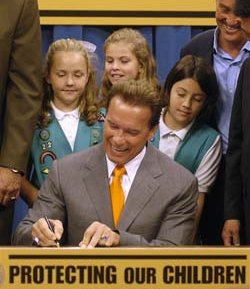
Governor Arnold Schwarznegger signs a bill restricting the sale of violent video games to minors.
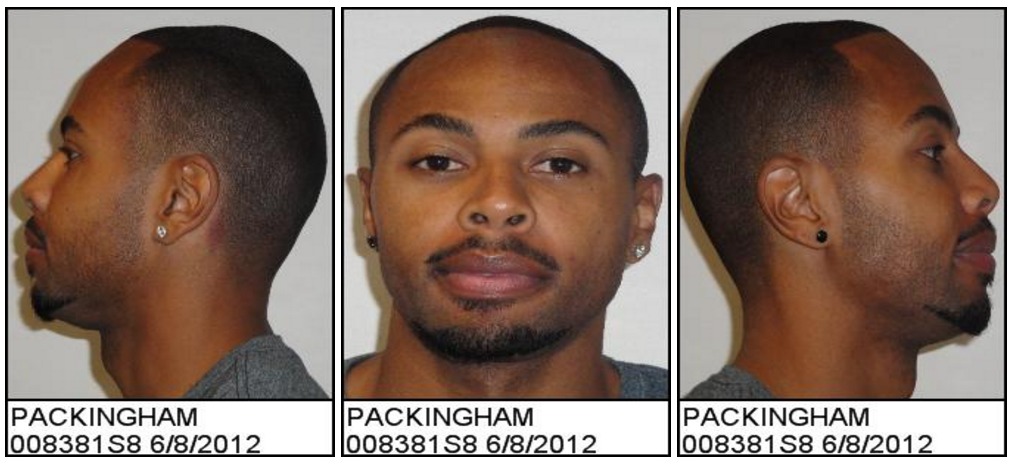
Lester Packingham challenged a North Carolina law that prohibited registered sex offenders from accessing social media sites.
