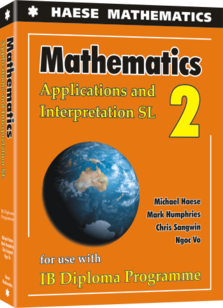
This book has been written for the IB Diploma Programme course Mathematics: Applications and Interpretation SL, for first assessment in May 2021.
This book is designed to complete the course in conjunction with the Mathematics: Core Topics SL textbook. It is expected that students will start using this book approximately 6-7 months into the two-year course, upon the completion of the Mathematics: Core Topics SL textbook.
This product has been developed independently from and is not endorsed by the International Baccalaureate Organization. International Baccalaureate, Baccalaureát International, Bachillerato Internacional and IB are registered trademarks owned by the International Baccalaureate Organization.
Year Published: 2019
Page Count: 504
ISBN: 978-1-925489-57-6 (9781925489576)
Online ISBN: 978-1-925489-69-9 (9781925489699)
| 1 | APPROXIMATIONS AND ERROR | 15 | |
| A | Rounding numbers | 16 | |
| B | Approximations | 20 | |
| C | Errors in measurement | 22 | |
| D | Absolute and percentage error | 25 | |
| Review set 1A | 29 | ||
| Review set 1B | 30 | ||
| 2 | LOANS AND ANNUITIES | 31 | |
| A | Loans | 32 | |
| B | Annuities | 38 | |
| Review set 2A | 43 | ||
| Review set 2B | 44 | ||
| 3 | FUNCTIONS | 45 | |
| A | Relations and functions | 46 | |
| B | Function notation | 49 | |
| C | Domain and range | 53 | |
| D | Graphs of functions | 57 | |
| E | Sign diagrams | 60 | |
| F | Transformations of graphs | 63 | |
| G | Inverse functions | 69 | |
| Review set 3A | 73 | ||
| Review set 3B | 76 | ||
| 4 | MODELLING | 79 | |
| A | The modelling cycle | 80 | |
| B | Linear models | 86 | |
| C | Piecewise linear models | 89 | |
| D | Systems of equations | 94 | |
| Review set 4A | 96 | ||
| Review set 4B | 98 | ||
| 5 | BIVARIATE STATISTICS | 101 | |
| A | Association between numerical variables | 102 | |
| B | Pearson's product-moment correlation coefficient | 107 | |
| C | Line of best fit by eye | 112 | |
| D | The least squares regression line | 116 | |
| E | Spearman's rank correlation coefficient | 123 | |
| Review set 5A | 128 | ||
| Review set 5B | 130 | ||
| 6 | QUADRATIC FUNCTIONS | 133 | |
| A | Quadratic functions | 135 | |
| B | Graphs from tables of values | 137 | |
| C | Axes intercepts | 139 | |
| D | Graphs of the form $y = ax^2$ | 141 | |
| E | Graphs of quadratic functions | 143 | |
| F | Axis of symmetry | 144 | |
| G | Vertex | 147 | |
| H | Finding a quadratic from its graph | 149 | |
| I | Intersection of graphs | 152 | |
| J | Quadratic models | 153 | |
| Review set 6A | 159 | ||
| Review set 6B | 161 | ||
| 7 | DIRECT AND INVERSE VARIATION | 163 | |
| A | Direct variation | 164 | |
| B | Powers in direct variation | 168 | |
| C | Inverse variation | 170 | |
| D | Powers in inverse variation | 172 | |
| E | Determining the variation model | 173 | |
| F | Using technology to find variation models | 175 | |
| Review set 7A | 178 | ||
| Review set 7B | 180 | ||
| 8 | EXPONENTIALS AND LOGARITHMS | 183 | |
| A | Exponential functions | 185 | |
| B | Graphing exponential functions from a table of values | 186 | |
| C | Graphs of exponential functions | 187 | |
| D | Exponential equations | 191 | |
| E | Growth and decay | 192 | |
| F | The natural exponential | 199 | |
| G | Logarithms in base $10$ | 204 | |
| H | Natural logarithms | 208 | |
| Review set 8A | 211 | ||
| Review set 8B | 213 | ||
| 9 | TRIGONOMETRIC FUNCTIONS | 217 | |
| A | The unit circle | 218 | |
| B | Periodic behaviour | 221 | |
| C | The sine and cosine functions | 224 | |
| D | General sine and cosine functions | 226 | |
| E | Modelling periodic behaviour | 231 | |
| Review set 9A | 236 | ||
| Review set 9B | 239 | ||
| 10 | DIFFERENTIATION | 241 | |
| A | Rates of change | 243 | |
| B | Instantaneous rates of change | 247 | |
| C | Limits | 251 | |
| D | The gradient of a tangent | 252 | |
| E | The derivative function | 254 | |
| F | Differentiation | 256 | |
| G | Rules for differentiation | 259 | |
| Review set 10A | 265 | ||
| Review set 10B | 267 | ||
| 11 | PROPERTIES OF CURVES | 269 | |
| A | Tangents | 270 | |
| B | Normals | 273 | |
| C | Increasing and decreasing | 276 | |
| D | Stationary points | 280 | |
| Review set 11A | 284 | ||
| Review set 11B | 285 | ||
| 12 | APPLICATIONS OF DIFFERENTIATION | 287 | |
| A | Rates of change | 288 | |
| B | Optimisation | 293 | |
| C | Modelling with calculus | 301 | |
| Review set 12A | 303 | ||
| Review set 12B | 304 | ||
| 13 | INTEGRATION | 307 | |
| A | Approximating the area under a curve | 308 | |
| B | The Riemann integral | 313 | |
| C | The Fundamental Theorem of Calculus | 317 | |
| D | Antidifferentiation and indefinite integrals | 320 | |
| E | Rules for integration | 322 | |
| F | Particular values | 324 | |
| G | Definite integrals | 325 | |
| H | The area under a curve | 328 | |
| Review set 13A | 331 | ||
| Review set 13B | 333 | ||
| 14 | DISCRETE RANDOM VARIABLES | 335 | |
| A | Random variables | 336 | |
| B | Discrete probability distributions | 338 | |
| C | Expectation | 342 | |
| D | The binomial distribution | 347 | |
| E | Using technology to find binomial probabilities | 352 | |
| F | The mean and standard deviation of a binomial distribution | 355 | |
| Review set 14A | 357 | ||
| Review set 14B | 358 | ||
| 15 | THE NORMAL DISTRIBUTION | 361 | |
| A | Introduction to the normal distribution | 363 | |
| B | Calculating probabilities | 366 | |
| C | Quantiles | 373 | |
| Review set 15A | 377 | ||
| Review set 15B | 378 | ||
| 16 | HYPOTHESIS TESTING | 381 | |
| A | Statistical hypotheses | 382 | |
| B | Student's $t$-test | 384 | |
| C | The two-sample $t$-test for comparing population means | 393 | |
| D | The$\chi^2$ goodness of fit test | 395 | |
| E | The$\chi^2$ test for independence | 405 | |
| Review set 16A | 413 | ||
| Review set 16B | 415 | ||
| 17 | VORONOI DIAGRAMS | 417 | |
| A | Voronoi diagrams | 418 | |
| B | Constructing Voronoi diagrams | 422 | |
| C | Adding a site to a Voronoi diagram | 427 | |
| D | Nearest neighbour interpolation | 431 | |
| E | The Largest Empty Circle problem | 433 | |
| Review set 17A | 437 | ||
| Review set 17B | 439 | ||
| ANSWERS | 441 | ||
| INDEX | 503 | ||

Michael completed a Bachelor of Science at the University of Adelaide, majoring in Infection and Immunity, and Applied Mathematics. He studied laminar heat flow as part of his Honours in Applied Mathematics, and finished a PhD in high speed fluid flows in 2001. He has been the principal editor for Haese Mathematics since 2008.
What motivates you to write mathematics books?
My passion is for education as a whole, rather than just mathematics. In Australia I think it is too easy to take education for granted, because it is seen as a right but with too little appreciation for the responsibility that goes with it. But the more I travel to places where access to education is limited, the more I see children who treat it as a privilege, and the greater the difference it makes in their lives. But as far as mathematics goes, I grew up with mathematics textbooks in pieces on the kitchen table, and so I guess it continues a tradition.
What do you aim to achieve in writing?
I think a few things:
What interests you outside mathematics?
Lots of things! Horses, show jumping and course design, alpacas, badminton, running, art, history, faith, reading, hiking, photography .

Mark has a Bachelor of Science (Honours), majoring in Pure Mathematics, and a Bachelor of Economics, both of which were completed at the University of Adelaide. He studied public key cryptography for his Honours in Pure Mathematics. He started with the company in 2006, and is currently the writing manager for Haese Mathematics.
What got you interested in mathematics? How did that lead to working at Haese Mathematics?
I have always enjoyed the structure and style of mathematics. It has a precision that I enjoy. I spend an inordinate amount of my leisure time reading about mathematics, in fact! To be fair, I tend to do more reading about the history of mathematics and how various mathematical and logic puzzles work, so it is somewhat different from what I do at work.
How did I end up at Haese Mathematics?
I was undertaking a PhD, and I realised that what I really wanted to do was put my knowledge to use. I wanted to pass on to others all this interesting stuff about mathematics. I emailed Haese Mathematics (Haese and Harris Publications as they were known back then), stating that I was interested in working for them. As it happened, their success with the first series of International Baccalaureate books meant that they were looking to hire more people at the time. I consider myself quite lucky!
What are some interesting things that you get to do at work?
On an everyday basis, it’s a challenge (but a fun one!) to devise interesting questions for the books. I want students to have questions that pique their curiosity and get them thinking about mathematics in a different way. I prefer to write questions that require students to demonstrate that they understand a concept, rather than relying on rote memorisation.
When a new or revised syllabus is released for a curriculum that we write for, a lot of work goes into devising a structure for the book that addresses the syllabus. The process of identifying what concepts need to be taught, organising those concepts into an order that makes sense from a teaching standpoint, and finally sourcing and writing the material that addresses those concepts is very involved – but so rewarding when you hold the finished product in your hands, straight from the printer.
What interests you outside mathematics?
Apart from the aforementioned recreational mathematics activities, I play a little guitar, and I enjoy playing badminton and basketball on a social level.
